
Deep dive
ISRO and its rockets
From the first rocket that flew from Thumba in 1963 to GSLV-F18, which flew on the night of 30 October 2026: how ISRO's rockets were built, how they fly, and which orbits they carry satellites to. Every topic has something you can run and try.

The big questions in this deep dive
- How does a rocket move in space, where there is no air, and why does it have several stages?
- How are PSLV, GSLV and LVM3 different?
- What happened, step by step, on the GSLV-F18 flight, and what will NVS-03 do next?
- How does NavIC tell you where you are, and why does it need at least four satellites?
- Why do India's big rockets fly only from Sriharikota?
Progress is kept only in this browser. Nothing is sent anywhere.
1Beginnings: from Thumba to SLV-3
1962: it starts with INCOSPAR
In 1962 a committee called INCOSPAR was set up under the Department of Atomic Energy. This is where ISRO's story begins.
1963: the first rocket from Thumba
On 21 November 1963 the first rocket flew from the rocket station at Thumba (TERLS). It was a Nike-Apache, a two-stage sounding rocket: a rocket that goes up, takes measurements and then comes back down, without going into orbit.
1969: ISRO is formed
On 15 August 1969 the Indian Space Research Organisation (ISRO) was formed in place of INCOSPAR. In June 1972 the Space Commission and the Department of Space were set up, and in September 1972 ISRO was brought under this department.
1975: Aryabhata, the first satellite
India's first satellite, Aryabhata, went into space on 19 April 1975 on a rocket of the Soviet Union (USSR). It weighed 360 kg. The satellite was India's, but the rocket belonged to another country.
The Sriharikota centre
In 1969 Sriharikota island in Andhra Pradesh was chosen for a rocket launch centre. On 9 October 1971 a sounding rocket called Rohini-125 flew from there, and the centre began work. On 5 September 2002 it was named Satish Dhawan Space Centre SHAR (SDSC SHAR), after Prof. Satish Dhawan, a former Chairman of ISRO.
1980: SLV-3 puts Rohini in orbit
The first attempt at building India's own rocket was SLV-3. Its first flight, in August 1979, was not fully successful. On 18 July 1980 SLV-3 placed the Rohini (RS-1) satellite in orbit from Sriharikota, and India became the sixth member of the select group of space-faring nations. The Project Director of SLV-3 was Dr A.P.J. Abdul Kalam.
| When | What happened |
|---|---|
| 1962 | INCOSPAR set up under the Department of Atomic Energy |
| 21 November 1963 | First rocket from Thumba, a Nike-Apache |
| 1969 | Sriharikota chosen for a rocket launch centre |
| 15 August 1969 | ISRO formed |
| 9 October 1971 | First rocket from Sriharikota, Rohini-125 |
| June 1972 | Space Commission and Department of Space set up (ISRO brought under the department in September 1972) |
| 19 April 1975 | First Indian satellite, Aryabhata, on a Soviet rocket |
| 18 July 1980 | SLV-3 placed the Rohini (RS-1) satellite in orbit |
| 20 September 1993 | First flight of PSLV (not successful); first successful flight in October 1994 |
| 18 April 2001 | First flight of GSLV |
| 5 September 2002 | Sriharikota centre named Satish Dhawan Space Centre SHAR |
| 22 October 2008 | Chandrayaan-1, on PSLV-C11 |
| 5 January 2014 | GSLV-D5: successful GSLV flight with an Indian-built cryogenic stage |
| 24 September 2014 | Mangalyaan (Mars Orbiter Mission) in orbit around Mars |
| 15 February 2017 | PSLV-C37: 104 satellites on one flight |
| 5 June 2017 | First orbital flight of LVM3 (LVM3-D1, GSAT-19) |
| 23 August 2023 | Chandrayaan-3 made a soft landing on the Moon |
| 16 January 2025 | SpaDeX: docking of two spacecraft in space |
| 30 October 2026 | GSLV-F18 placed NVS-03 in GTO |
Think
Aryabhata went up in 1975 on another country's rocket, but in 1980 India sent a satellite on its own rocket. Why does having your own rocket matter so much?
See the answer
A country with its own rocket can send its satellites when it needs to and on its own schedule; it does not have to wait for another country to say yes. That is why the SLV-3 flight of 18 July 1980 is a big milestone for India. You will see the same point again later, in the story of the cryogenic engine.
Checkpoint✓ Stop complete
1When was ISRO formed?
In 1962 INCOSPAR was set up under the Department of Atomic Energy. On 15 August 1969 ISRO was formed in its place. In 1975 the Aryabhata satellite went up.
2Which rocket took India's first satellite, Aryabhata, into space?
Aryabhata went up on 19 April 1975 on a rocket of the Soviet Union. India's own rocket, SLV-3, placed the Rohini satellite in orbit on 18 July 1980.
3Who was the Project Director of SLV-3?
Dr Kalam was the Project Director of SLV-3. Prof. Satish Dhawan was Chairman of ISRO; in 2002 the Sriharikota centre was named after him.
2How does a rocket fly?
Learn it from a balloon: thrust
Blow up a balloon and let it go: the air rushes out of the back and the balloon shoots forward. A rocket does the same. In the engine, fuel burns to make very hot gas, which rushes out downwards at high speed; in return, the rocket is pushed upwards. This is Newton's third law: every action has an equal and opposite reaction. This push is called thrust.
It works without air
A rocket does not need outside air to push against. The rocket throws out the gas itself, so it works in a vacuum too. It also carries with it the oxidiser it needs to burn its fuel. Fuel and oxidiser together are called propellant.
The speed to stay in orbit
Going up is not enough. To stay in orbit, a satellite has to race sideways around the Earth very fast. At a height of 200 to 400 km this orbital speed is about 7.8 km every second, or about 28,000 km per hour. Moving this fast, the satellite does keep falling, but it falls along the curve of the Earth, so it never reaches the ground.
Why a rocket has stages
Most of a rocket's weight is its propellant. As the propellant burns, the empty tanks become dead weight. So a rocket is built in several stages: when one stage runs out of propellant, its empty tank and engine separate and fall away, and the lighter rocket that is left carries on.
The rocket equation
How much speed each stage adds comes from Tsiolkovsky's rocket equation: Δv = ve × ln(m0 / mf). Here ve is the speed of the escaping gas, m0 is the total mass before the stage burns and mf the mass after it burns. The more dead weight is dropped, the smaller mf and the greater the speed.
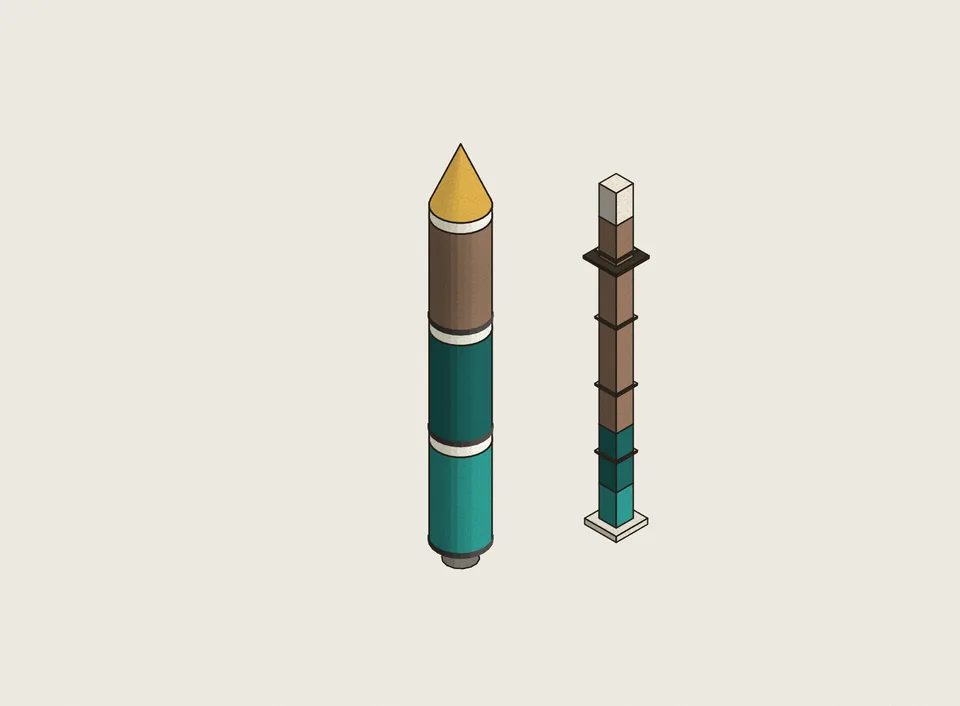 Play
Toy rocket stages in 3D
Say the rocket weighs 100 tonnes, with a 1-tonne satellite on top, and the gas leaves at 3 km/s. These are toy numbers, not those of any real rocket. Pick one, two or three stages, change the propellant share and press Play: the empty stages drop away one by one. A real rocket also has to fight air drag and the pull of the Earth (gravity), so what it really needs is quite a lot more than 7.8 km/s.
3D figure: Colorfigures (April Zhu), MIT licence.
Three kinds of propellant
Solid
A solid propellant called HTPB. GSLV's S139 core, both S200 boosters of LVM3, the third stage of PSLV (PS3) and all three solid stages of SSLV run on it.
Liquid
Liquids that can be kept in a tank at ordinary temperatures. All four L40H strap-ons of GSLV and its second stage GS2 (Vikas engine) run on UH25 fuel and N2O4 oxidiser. The second stage of PSLV (PS2, Vikas engine) takes UDMH + N2O4, and the fourth stage (PS4) MMH + MON.
Cryogenic
Liquid hydrogen (LH2) and liquid oxygen (LOX). Hydrogen boils at −253 °C and oxygen at −183 °C, so the tanks have to be kept very cold and well insulated. Hydrogen is very light, so its tank is large. Of the three, this gives the most push for every kilo of propellant, but it is the hardest to build and to handle. GSLV's upper stage (CUS) and LVM3's C25 stage are cryogenic.
Think
In the toy rocket, adding stages increased the speed. So why not build ten stages?
See the answer
Each new stage adds only a little more speed; the gain keeps shrinking. Each stage also needs its own engine, joints and separation system, which are weight themselves, and every separation is one more place where something can go wrong. That is why ISRO's rockets have three to five stages (see the next topic).
Checkpoint✓ Stop complete
1How can a rocket move even in the vacuum of space?
This is Newton's third law. It needs no outside air to push against, and the rocket carries its oxidiser with it too.
2At a height of 200 to 400 km, about how much speed is needed to stay in orbit?
About 7.8 km every second, or about 28,000 km per hour.
3Why are rockets built in several stages?
An empty tank is dead weight. Dropping it makes mf smaller, so the next stage can add more speed.
3ISRO's family of rockets
Six rockets on one scale
Below, six ISRO rockets stand on one scale, next to a 1.7-metre man. Pick a rocket and its full profile appears below. The bars at the bottom show the mass at lift-off, because height alone does not tell you how powerful a rocket is.
SLV-3 and ASLV
SLV-3 and ASLV were small rockets, all of whose stages used solid propellant. Of ASLV's four flights, those of 1987 and 1988 did not succeed; those of 1992 and May 1994 succeeded.
PSLV: four stages, many versions
PSLV is a four-stage rocket: solid, liquid, solid, liquid. It comes in different versions for different needs: XL has 6 strap-ons, QL 4, DL 2, and CA none at all. PSLV has launched Chandrayaan-1, Mangalyaan, Aditya-L1 and 104 satellites on one flight. Up to PSLV-C62 (12 January 2026) it had flown 64 times. The flights of 1993 (PSLV-D1), 31 August 2017 (PSLV-C39) and 18 May 2025 (PSLV-C61) did not succeed. On PSLV-C62 an anomaly came up towards the end of the third stage (PS3). In February 2026 a national expert committee was looking into its cause.
GSLV, LVM3 and SSLV
GSLV can carry 2,250 kg to geosynchronous transfer orbit (GTO). It has made 20 flights up to GSLV-F18; the flights of 2006 (F02), 2010 (D3 and F06) and 2021 (F10) did not succeed. LVM3 is the heaviest: two large solid S200 boosters, a liquid L110 stage in the middle (two Vikas engines) and a cryogenic C25 on top. Up to LVM3-M6 (24 December 2025) it had made 9 flights, and none is recorded as a failure. SSLV is the newest of these (first flight 7 August 2022); it carries a satellite of about 500 kg to a 500 km orbit.
Planned next: NGLV
The plan ahead: the Union Cabinet approved the development of the next-generation rocket, NGLV (Next Generation Launch Vehicle), in September 2024. The aim is to carry up to 30 tonnes to low Earth orbit (LEO), with a first stage that can be used again (reusable). The plan has three development flights, 96 months and ₹8,240 crore. NGLV has not been built yet, so it is not drawn here.
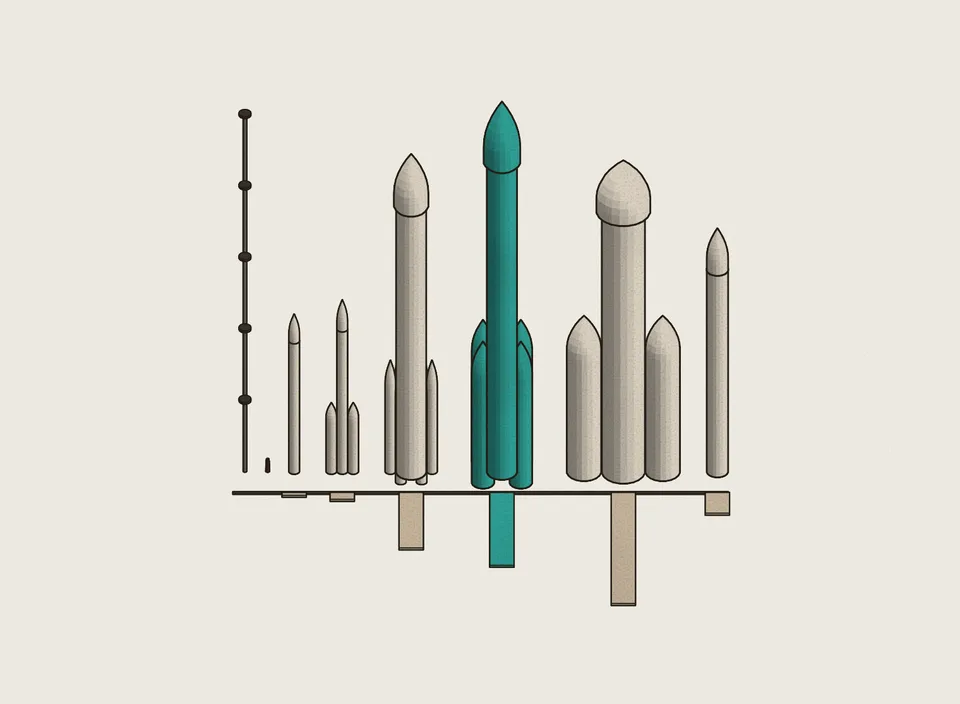 Play
Six rockets, one scale, in 3D
Height is to scale (each mark on the pole is 10 m, beside a 1.7 m person); width is drawn only roughly. The bars on the ground show the mass at lift-off. Press a rocket's button; drag with a finger or the mouse to turn the row.
3D figure: Colorfigures (April Zhu), MIT licence.
Think
GSLV is the tallest of these six, so why are heavy satellites sent on LVM3?
See the answer
Power is not measured by height. At lift-off LVM3 weighs about 640 tonnes, GSLV about 420 tonnes. LVM3 can carry about 4,000 kg to GTO, while GSLV carries about 2,250 kg. The mass bars at the bottom show exactly this.
Checkpoint✓ Stop complete
1What kind are GSLV's four strap-ons?
In GSLV's first stage, the S139 in the middle is solid and the four L40H strap-ons around it are liquid.
2Of these six, which rocket is the heaviest at lift-off?
LVM3 weighs about 640 tonnes, GSLV about 420 tonnes and PSLV-XL about 320 tonnes. GSLV is the tallest (51.73 m), but LVM3 leads on weight.
3What is true about NGLV?
NGLV is the next-generation rocket whose development the Union Cabinet approved in September 2024. It is still a plan.
4Which orbit for a satellite?
Higher orbit, slower trip
How high a satellite circles, and in which direction, depends on the job it has to do. Remember one rule: the higher the orbit, the slower and longer each trip round the Earth.
Low Earth orbit (LEO)
Low Earth orbit (LEO) is a few hundred km up. At 400 km a satellite goes once round the Earth in about 92 minutes. In the picture below, see how this orbit seems almost to hug the Earth.
Polar and sun-synchronous orbits
Polar satellites pass over close to the poles. In a sun-synchronous polar orbit (SSPO) a satellite passes over each place at the same local time every day. PSLV can carry 1,750 kg to such an orbit at 600 km.
Geostationary and geosynchronous
Geostationary orbit lies right above the equator, at a height of 35,786 km. There a satellite goes round in exactly the time the Earth takes to turn on its axis: one sidereal day, about 23 hours 56 minutes. So from the ground it seems to stay fixed at one spot in the sky. A satellite whose trip round takes this same time is a geosynchronous satellite; if its orbit is tilted from the equator, its path over the ground makes a figure 8.
First into GTO
A rocket does not take a satellite straight there. It first leaves it in a geosynchronous transfer orbit (GTO): a long oval path whose end nearest the Earth is called the perigee and whose farthest end is called the apogee. For GSLV-F18 the plan was: perigee 170 km, apogee 37,023 km, and a tilt from the equator (inclination) of 20.75°.
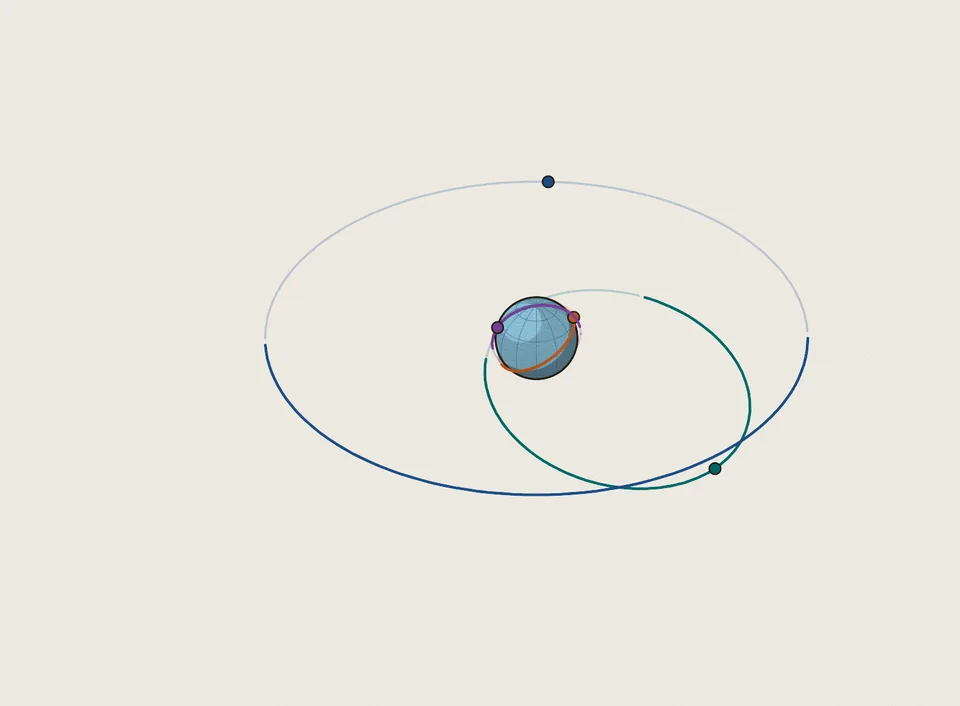 Play
Five orbits in 3D
The Earth and all the orbits are on one scale. Press an orbit's button to hide or show it; drag with a finger or the mouse to turn the picture.
3D figure: Colorfigures (April Zhu), MIT licence.
Think
A geostationary satellite is racing along at about 3 km/s. So why, from the ground, does it seem to stay fixed at one spot in the sky?
See the answer
Because the Earth also goes round once, in the same direction and in exactly the same time: about 23 hours 56 minutes. The satellite and the ground turn together, so from the ground it seems to stand still. That is why a dish on the roof, once pointed the right way, does not need turning again and again.
Checkpoint✓ Stop complete
1How high above the equator is a geostationary satellite?
At 35,786 km one trip round takes exactly one sidereal day (about 23 hours 56 minutes).
2What is GTO?
GTO's perigee is close to the Earth and its apogee is around geostationary height. For GSLV-F18 the plan was 170 × 37,023 km.
3Compared with a satellite in a low orbit, a satellite in a high orbit...
At 400 km one trip round takes about 92 minutes, and at 35,786 km about 23 hours 56 minutes.
5The story of the cryogenic engine
An Indian cryogenic stage: CUSP
GSLV's topmost stage is cryogenic. On the early GSLV flights this stage was bought from Russia. The aim of ISRO's Cryogenic Upper Stage Project (CUSP) was to build such a stage in India itself, to take the place of the stage bought from Russia.
The 1992 sanctions
In 1992 the United States imposed sanctions over a deal to get cryogenic engine technology from Russia. ISRO ran a project to build its own cryogenic stage in place of the stage bought from Russia.
2010: two failed flights
The first GSLV flight with an Indian-built cryogenic stage was GSLV-D3, on 15 April 2010, carrying the GSAT-4 satellite. It did not succeed: the cryogenic engine could not burn for more than a second, because its Fuel Booster Turbo Pump stopped abnormally. On 25 December 2010 GSLV-F06, which had a Russian cryogenic stage, also failed.
2014: GSLV-D5 succeeds
On 5 January 2014 GSLV-D5 delivered the GSAT-14 satellite from the second launch pad at Sriharikota. This was GSLV's eighth flight. The flight succeeded, and it carried an Indian-built cryogenic stage.
From CE-7.5 to CE-20
GSLV's cryogenic engine, CE-7.5, gives about 7.5 tonnes of thrust. For the bigger rocket LVM3, India built the far more powerful CE-20 engine, with about 19 to 20 tonnes of thrust. On 16 July 2015 CE-20 was tested at the ISRO Propulsion Complex in Mahendragiri by firing it non-stop for 800 seconds. On 5 June 2017 LVM3 delivered GSAT-19 on its first orbital flight (LVM3-D1).
Why is cryogenic hard?
Very cold
Hydrogen turns to gas above −253 °C, and oxygen above −183 °C. Tanks, pipes and pumps must work properly even in this cold.
Very light hydrogen
Liquid hydrogen is very light, so the same number of kilos needs a big tank.
But the most push
For every kilo of propellant it gives more push than solid or ordinary liquid propellant. That is just what an upper stage needs, where every kilo saved is precious.
Think
When the stage could be bought from Russia, why did India insist on building its own engine, even after its first flight (GSLV-D3) failed?
See the answer
With something you buy, the seller and world politics have the final say. With its own engine, India can build GSLVs whenever it wants and as many as it wants. Later, LVM3's bigger CE-20 engine was also built in India.
Checkpoint✓ Stop complete
1Why did the GSLV-D3 flight (15 April 2010) not succeed?
The Fuel Booster Turbo Pump stopped abnormally, and the engine could not burn for more than a second.
2Which was the successful GSLV flight with an Indian-built cryogenic stage?
GSLV-D5 delivered GSAT-14 on 5 January 2014. GSLV-D3 failed, and GSLV-F06 had a Russian stage.
3Why does cryogenic propellant have to be kept so cold?
To stay liquid, hydrogen has to be kept below −253 °C and oxygen below −183 °C.
6News: GSLV-F18 delivers NVS-03
The night of 30 October 2026
On the night of 30 October 2026 the GSLV-F18 rocket lifted off from the second launch pad of the Satish Dhawan Space Centre at Sriharikota. It placed NavIC's new satellite NVS-03 in geosynchronous transfer orbit (GTO). The satellite reached its intended orbit. NVS-03 carries an Indian-built atomic clock as well as procured atomic clocks, and it sends signals in the L1 band as well as the L5 and S bands.
20th GSLV, 107th launch
This was GSLV's 20th flight and ISRO's 107th launch from Sriharikota. It was ISRO's third launch of 2026; before it, PSLV-C62 flew on 12 January and GSLV-F17 (with the EOS-05 satellite) on 4 September.
How GSLV-F18 is built
GSLV-F18 was about 50 metres tall and weighed about 420 tonnes at lift-off. It has three stages. First stage (GS1): a solid S139 core in the middle (20.1 m long, 138.2 tonnes of propellant) with four liquid L40H strap-ons around it (each 19.6 m long; 170.6 tonnes of propellant in all four together). Second stage (GS2): a liquid stage with the Vikas engine (42.1 tonnes of propellant). Third stage: the cryogenic CUS15 (14.4 tonnes of liquid hydrogen and liquid oxygen). At the very top, a 3.4-metre metal shell (payload fairing), with the satellite of about 2,250 kg inside.
A flight of about 19 minutes
On a GSLV flight like this, it takes about 19 minutes from launch until the satellite separates: on 29 May 2023 GSLV-F12 released NVS-01 after a flight of about 19 minutes. The animation below shows the nine steps of the flight in the order in which they come.
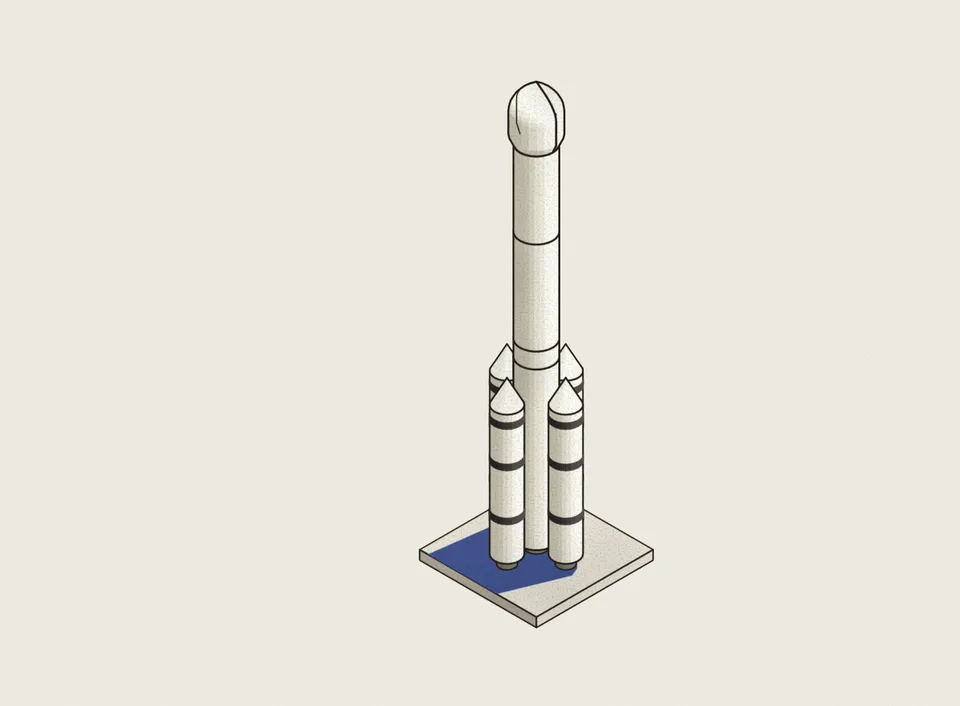 Play
GSLV-F18 in 3D
Press the buttons in order; drag with a finger or the mouse to turn the rocket. "See-through" shows the propellant in each stage.
3D figure: Colorfigures (April Zhu), MIT licence.
After the satellite separates
Planned orbit
GTO: perigee 170 km, apogee 37,023 km, inclination 20.75°. These are the planned figures.
Next step
Now NVS-03 will fire its own engine several times near apogee to raise its orbit and make it round, so that it reaches geosynchronous orbit. This is still to happen.
The lesson of NVS-02 (2025)
On 29 January 2025 GSLV-F15 had placed NVS-02 in GTO; this was the 100th launch from Sriharikota. But the satellite's orbit could not be changed from an oval to a circle. The signal to work the pyro valve on the oxidiser line of the orbit-raising engine (drive signal) did not reach it; the most likely cause was the contact in a connector. The fixes for this were applied on the CMS-03 satellite (LVM3-M5, 2 November 2025). The lesson: reaching GTO is half the journey; the satellite has to do the rest of the climb itself.
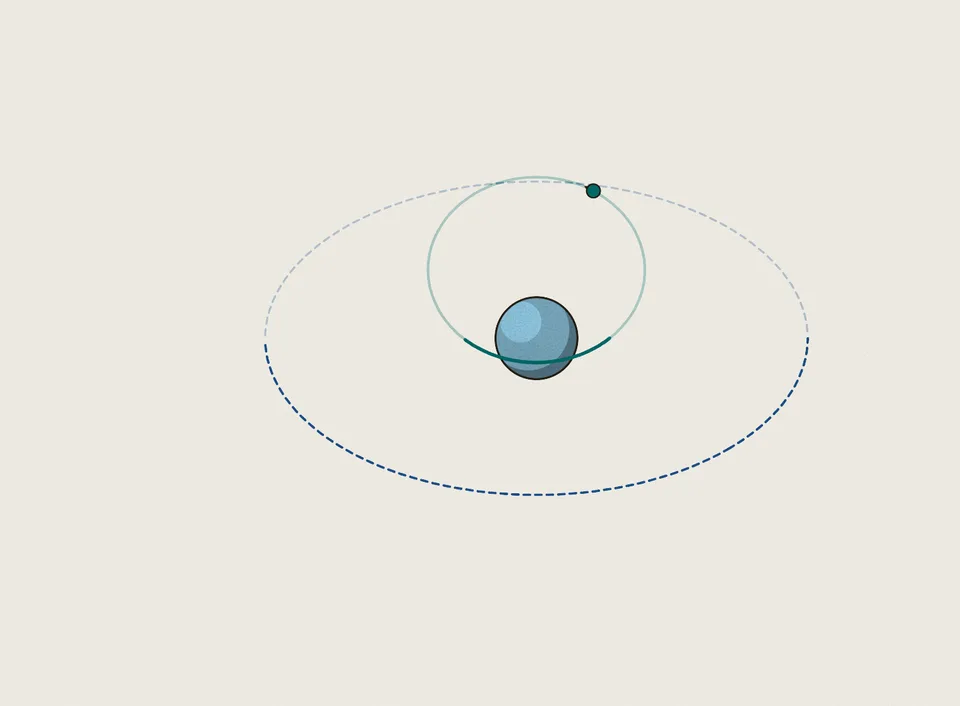 Play
From GTO to a round orbit, in 3D
The Earth and both orbits are to scale. Near perigee the satellite races, near apogee it slows. "Raise the orbit" shows the next step, and "NVS-02 (2025)" shows what happened to it.
3D figure: Colorfigures (April Zhu), MIT licence.
Think
Why does a rocket not go straight up? Why does its flight path keep tilting towards the east?
See the answer
To stay in orbit, sideways speed matters more than height: about 7.8 km/s or more. So as soon as the rocket is out of the thick air it keeps tilting over and puts most of its power into building up speed towards the east. Going east also gives it the Earth's own spin speed for free; more on this in the Sriharikota topic.
Checkpoint✓ Stop complete
1Where did GSLV-F18 leave NVS-03?
The rocket left the satellite in GTO. Next, the satellite will raise its orbit and make it round with its own engine.
2On the GSLV-F18 flight, which stage burns the longest?
The cryogenic stage burns for more than ten minutes; S139 for about 100 seconds and GS2 for about 150 seconds.
3What was the lesson of NVS-02 (2025)?
GSLV-F15 had placed NVS-02 in GTO. The trouble came later: the signal did not reach the valve of the orbit-raising engine.
7NavIC: India's own navigation system
From IRNSS to NavIC
NavIC used to be called IRNSS (Indian Regional Navigation Satellite System). On 28 April 2016 its seventh satellite, IRNSS-1G, was launched, completing the seven-satellite constellation. That same day Prime Minister Narendra Modi dedicated the system to the nation under the name "NavIC" (Navigation with Indian Constellation). It is built to meet the country's positioning, navigation and timing needs.
Area, accuracy and two services
NavIC is India's own satellite navigation system, which tells you direction and position. It is built for India and the region up to 1,500 km around it, and in the main region it is expected to be accurate to better than 20 metres. It has a Standard Positioning Service for ordinary users and an encrypted Restricted Service for strategic users.
Three bands: L5, S, L1
NavIC's signals come in three frequency bands: L5 (1176.45 MHz), S (2492.028 MHz) and L1 (1575.42 MHz). L1 came with the NVS series: NavIC satellites from 2023 onwards are built to send the standard service signals in all three bands. L1 signals can work together with the signals of other satellite navigation systems (GNSS): they are interoperable.
How it finds your position
Distance from a clock
How does it work? Every satellite has a very precise atomic clock, and it keeps announcing: here I am, and this is the time right now. Your phone checks how long the signal took to arrive. Distance = speed of light × time. Light travels about 300,000 km every second, so even an error of one microsecond (a millionth of a second) turns into a mistake of about 300 metres.
Why four satellites
The distances to three satellites give the three unknowns of position (forward-back, left-right, up-down). But the phone's own clock is cheap and can be wrong: that is a fourth unknown. So at least four satellites are needed to tell your position.
A net of seven satellites
Seven satellites, two kinds of orbit
NavIC is designed as seven satellites, plus their stations on the ground (ground stations), which work 24 hours a day, 7 days a week. Three of the satellite places are in geostationary orbit (GEO): right above the equator, at longitudes 32.5°E, 83°E and 129.5°E. The other four are in inclined geosynchronous orbit (IGSO). These two orbits are tilted at 29° (their inclination), they cross the equator at 55°E and 111.75°E, and each orbit has two satellites.
Over India all day
Both kinds of orbit are about 35,786 km up, and one trip round takes as long as one turn of the Earth (about 23 hours 56 minutes). So a geostationary satellite seems fixed at one spot in the sky. An inclined one also stays near its own longitude, but through the day it swings from 29° north to 29° south latitude, and its path over the ground makes a figure 8. In this way all seven stay in the sky over India and the region around it all day, and they stay spread out too: east-west and north-south.
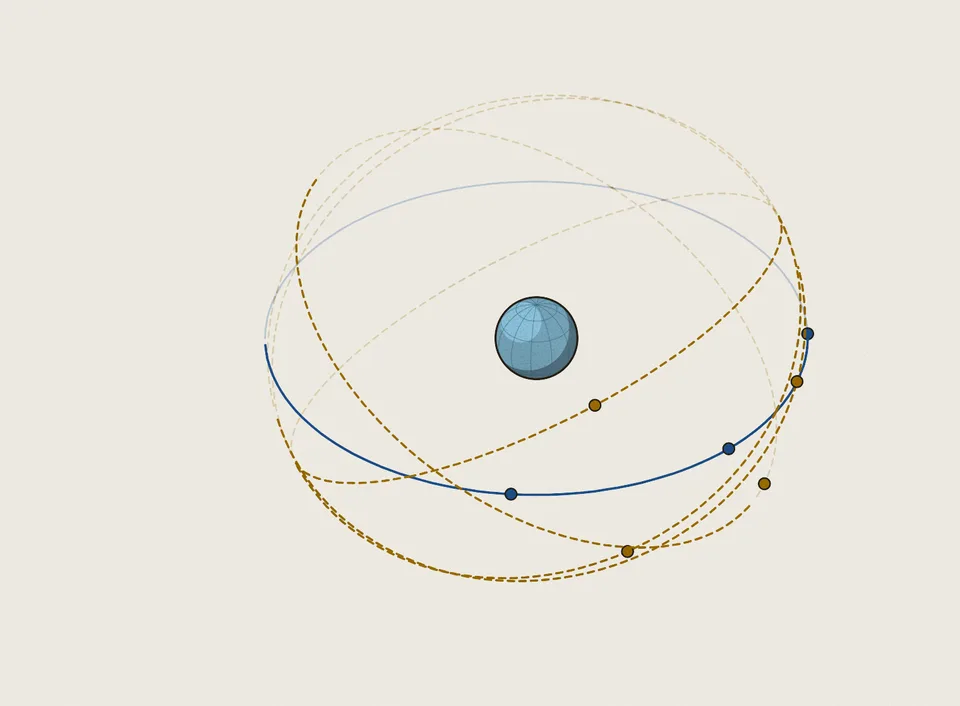 Play
All seven satellites in 3D
In "From space" each tilted satellite moves on its own circle; in "From the ground" two of them share each figure-8. Pick an hour or press Play; drag to turn the picture. The space view is to scale; the satellites are drawn larger so you can see them.
3D figure: Colorfigures (April Zhu), MIT licence.
Think
What would go wrong if all seven satellites sat above the equator?
See the answer
Then they would all be in one strip of the sky, almost in a line. A position comes out well only when the satellites are spread in different directions across the sky. The four inclined satellites add spread to the north and south, and because they are geosynchronous they still stay in the sky over the India region.
The satellites' story
2013 to 2016: the first seven
The first seven IRNSS satellites, IRNSS-1A to IRNSS-1G, were launched on PSLV rockets between July 2013 and April 2016. The first, IRNSS-1A (1 July 2013, PSLV-C22), went into the orbit tilted at 29° that crosses the equator at 55°E. IRNSS-1C went into geostationary orbit at 83°E, and the seventh, IRNSS-1G, at 129.5°E.
The clock trouble
Then came a big problem: three rubidium atomic clocks on IRNSS-1A failed. The cause turned out to be a small part: the feed-through capacitor that carries power (DC supply) to the main part of the clock (its physics package), which got into trouble when its temperature rose too much. The clocks of NavIC and of Europe's Galileo system had problems of a similar kind. Remember, the whole distance sum rests on the clock.
IRNSS-1H and 1I
IRNSS-1H was sent on 31 August 2017 on PSLV-C39 to take over navigation while 1A moved to messaging, but that flight did not succeed. Then on 12 April 2018 IRNSS-1I went up on PSLV-C41 to take 1A's place. Its atomic clocks were refurbished, and the clock fault had been corrected in them. IRNSS-1A was put to sending safety-of-life alerts, so that warnings of cyclones, tsunamis and high waves can reach fishermen. Such messages matter most where ground communication is poor or missing.
The second generation: NVS
To keep the service going, a second-generation series was planned: NVS, five satellites, NVS-01 to NVS-05. The first, NVS-01, went up on 29 May 2023 on GSLV-F12. It is planned to work for 12 years (its mission life), and it carries a rubidium atomic clock made in India by the Space Applications Centre (SAC), Ahmedabad: a technology only a handful of countries have. NVS-02 (29 January 2025, GSLV-F15) was to take IRNSS-1E's place at 111.75°E, but it could not raise its orbit.
Counting the satellites
Here is how the count went. By July 2025, 11 NavIC satellites had been launched: 4 were giving PNT, 4 were used for one-way messages, 1 had been switched off at the end of its service life, and 2 did not reach their intended orbit. In March 2026, 8 of the 11 were working: 3 were sending navigation signals and 5 could send one-way messages. NVS-03, launched on 30 October 2026, is NavIC's 12th satellite.
NavIC satellites: how are they doing now?
| Satellite | Launched | Status |
|---|---|---|
| IRNSS-1B | 4 April 2014 (PSLV-C24) | Providing position, navigation and timing (PNT) service |
| IRNSS-1I | 12 April 2018 (PSLV-C41), in place of 1A | Providing PNT service |
| NVS-01 | 29 May 2023 (GSLV-F12) | Providing PNT service |
| IRNSS-1F | 10 March 2016 (PSLV-C32) | Completed its 10-year design life on 10 March 2026; on 13 March 2026 its procured atomic clock stopped working; now one-way messaging only |
| IRNSS-1A | 1 July 2013 (PSLV-C22) | Three rubidium atomic clocks failed; IRNSS-1I took its place; it was then put to sending safety-of-life alerts |
| IRNSS-1C, 1D, 1E, 1G | 2014 to 2016 (PSLV-C26, C27, C31, C33) | Not now among the three satellites providing PNT |
| IRNSS-1H | 31 August 2017 (PSLV-C39) | Launch did not succeed |
| NVS-02 | 29 January 2025 (GSLV-F15) | Reached GTO, but its orbit could not be raised |
| NVS-03 | 30 October 2026 (GSLV-F18) | Reached GTO; next step is raising its orbit |
| NVS-04, NVS-05 | Not launched yet | In advanced stages of being built |
NavIC at work
Vehicles
By 2019, AIS-140 standard vehicle trackers that run on NavIC had been made compulsory in all commercial vehicles, and more than 75 companies were making such trackers. The Indian standard for NavIC in vehicle tracking is IS 16833:2018 (amendment-2).
Mobile phones
3GPP, the body that makes the standards for mobile networks, has accepted NavIC, so that NavIC can be made part of assisted GNSS. Its standard is 3GPP TS 36.171 (Release 16), which is for Assisted NavIC support in LTE mobile networks.
Trains
By July 2025, NavIC had been fitted along with other GNSS in about 8,700 trains, and the target was about 12,000.
At sea
For ships, the IMO (International Maritime Organization) recognises NavIC as part of the World Wide Radio Navigation System (WWRNS). IRNSS-1A has been put to carrying warnings of cyclones, tsunamis and high waves to fishermen.
Disaster warnings
In 2025, early warnings of disasters such as earthquakes, floods, cyclones and landslides were being sent through NavIC under SACHET, a project of NDMA. Besides navigation messages, NavIC's signal can carry text messages too.
Exact time
NavIC's satellites carry atomic clocks, so it gives very precise time too. In March 2026, spreading Indian Standard Time (IST dissemination) was among the uses of NavIC being widened.
What is GAGAN? (Not NavIC)
GAGAN (GPS Aided Geo Augmented Navigation) was built by ISRO and the Airports Authority of India (AAI) for civil aviation over Indian airspace. It is a satellite based augmentation system (SBAS): it uses satellites to correct GPS signals, which makes GPS better for aircraft. It is not a separate navigation system of its own. DGCA certified it for RNP 0.1 on 30 December 2013 and for APV-1 on 21 April 2015.
Try it yourself
If your phone has a setting or app that shows satellite information, look whether IRNSS/NavIC satellites show up in it.
See the answer
If they show up, your phone's receiver can pick up NavIC signals. If not, your phone can still find its position from GPS and the other systems, because receivers can use the signals of several systems together.
GPS and the others
| System | Country | Reach | Where the satellites are, how many |
|---|---|---|---|
| GPS | USA | Whole world | About 20,200 km up, in six orbital planes of medium Earth orbit (MEO); a commitment to at least 24 working satellites |
| NavIC | India | India and up to 1,500 km around | About 36,000 km up, in geostationary and inclined geosynchronous orbits; 7 in the design |
| QZSS | Japan | Regional | Four satellites from November 2018; now growing to seven |
| GLONASS | Russia | Whole world | — |
| Galileo | European Union | Whole world | — |
| BeiDou | China | Whole world | — |
Why seven are enough
Why does NavIC need only seven satellites when GPS needs at least 24? NavIC's satellites are very high (about 36,000 km) and stay over one region all day, so seven together can look after that region. GPS satellites are lower (about 20,200 km) and keep moving across the sky as they circle the whole Earth; for at least four to be in view everywhere in the world at every moment, many are needed. Many receivers today can use the signals of several systems together.
Where it stands now
July 2026: 3 giving PNT; at least 4 needed
In a written answer in the Lok Sabha in July 2026, the government said: basic position service needs at least four working satellites in orbit, so NavIC cannot give position on its own right now; but the timing service is working.
NVS-04 and NVS-05
In July 2026, NVS-04 and NVS-05 were in advanced stages of being built.
The March 2026 roadmap
The March 2026 roadmap had three points: complete NavIC's base layer constellation, improve its services, and bring in Indian-made technology, including a space-grade atomic clock, for self-reliance in technology.
Air traffic: still in talks
In March 2026, talks were going on with AAI and the Ministry of Civil Aviation (MoCA) about using NavIC in air traffic management. This is still a plan, not something in use.
Think
NVS-03 has reached GTO. Will NavIC now start giving position on its own again?
See the answer
Not yet. First NVS-03 has to raise its orbit with its own engine, reach its place and start work. Then, if IRNSS-1B, IRNSS-1I and NVS-01 keep working, there will be 3 + 1 = 4 working satellites, which is the minimum needed. Remember the NVS-02 story: reaching GTO is only half the journey.
Checkpoint✓ Stop complete
1In the real world, at least how many satellites are needed to tell your position?
Position has three unknowns, and the fourth unknown is the error in the phone's clock.
2An error of 1 microsecond in the clock causes about how big an error in distance?
Light travels about 300,000 km in one second, so about 300 metres in one microsecond.
3Which NavIC service was working in July 2026?
Three satellites were providing PNT, while at least four are needed. So there was no stand-alone position service, but the timing service was working.
4How many satellites is NavIC designed to have?
The design has seven satellites: three in geostationary orbit and four in inclined geosynchronous orbit. Twenty-four belongs to GPS, which has a commitment to at least 24 working satellites.
5Seen from the ground, what does the path of a NavIC satellite in inclined geosynchronous orbit (IGSO) look like?
The orbit is tilted at 29°, so through the day the satellite swings from 29° north to 29° south. One trip round takes as long as one turn of the Earth, so it stays near its own longitude and its path makes an 8.
6Why was IRNSS-1I launched on 12 April 2018?
Three rubidium clocks on IRNSS-1A had failed. IRNSS-1I went up with refurbished clocks to take its place. NavIC is a regional system, and GAGAN is a separate system.
7What is GAGAN?
GAGAN was built by ISRO and AAI for civil aviation. It corrects GPS signals; it is not a separate navigation system. Japan's system is QZSS.
8Which of these systems is regional, that is, built for one region?
NavIC is for India and the region up to 1,500 km around it. GPS and Galileo are for the whole world.
8Why Sriharikota?
Why Sriharikota
Sriharikota is a spindle-shaped island in SPSR Nellore district of Andhra Pradesh. To its west are Pulicat Lake and the Buckingham Canal, and to its east the Bay of Bengal. SDSC SHAR lists the reasons for choosing it: the country's east coast, away from where people live; a good corridor of launch directions for different missions (launch azimuth corridor); closeness to the equator, which helps launches towards the east; and a large empty area for safety.
A boost from the Earth's spin
Why does being close to the equator matter? The Earth spins from west to east. At the equator the ground moves east at about 465 metres per second; towards the poles this speed keeps falling (465 × cos latitude). At Sriharikota (about 13.7° N) it is about 452 m/s. A rocket launched towards the east gets this speed for free right from the start.
The sea to the east
Straight to the east lies the sea, so the flight path goes over the sea, and the spent stages fall into the water.
Two launch pads
There are two launch pads here. The first flight from the First Launch Pad was on 20 September 1993 (PSLV). The Second Launch Pad came into use in 2005; the first flight from it was made by PSLV with the Cartosat-1 satellite on 5 May 2005. GSLV-F18 also flew from the second launch pad.
Planned next: a third pad, a new centre
The plan ahead: the Union Cabinet approved the Third Launch Pad on 16 January 2025, with ₹3,984.86 crore; the target is to build it in 48 months. At Kulasekarapattinam in Tamil Nadu, the Prime Minister laid the foundation stone of a new launch centre for SSLV on 28 February 2024.
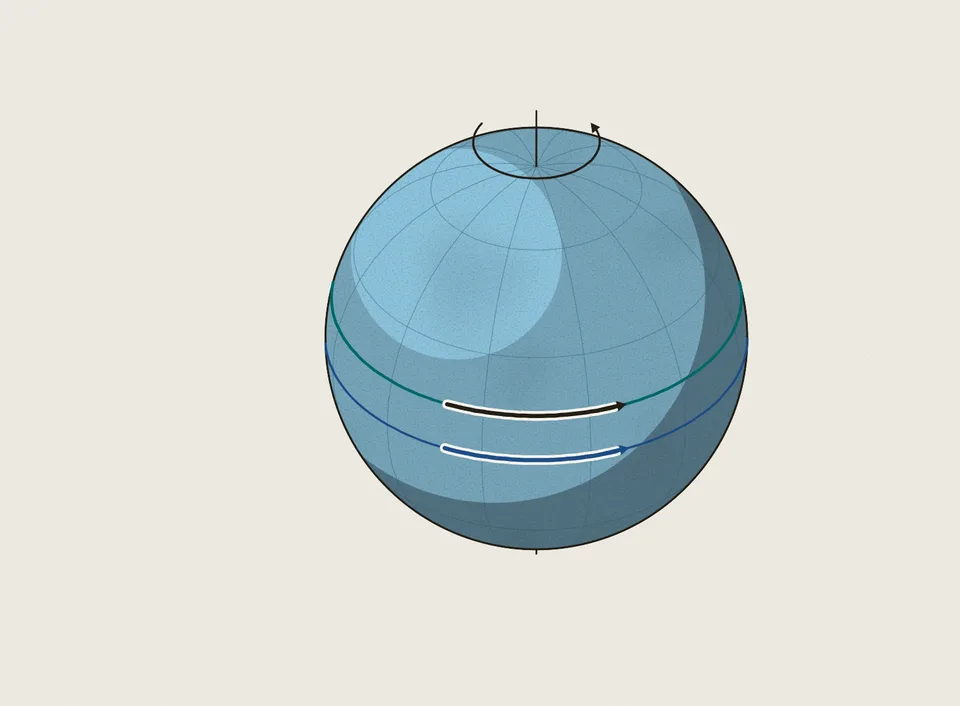 Play
The Earth's spin in 3D
Pick a latitude and watch the ground's eastward speed: fastest at the equator, less towards the poles. The figure also shows how much speed a rocket launched east or west has to add by itself (a rough sum). Drag to turn the Earth.
3D figure: Colorfigures (April Zhu), MIT licence.
Think
If India's big launch centre were on the west coast, what problem would come up in launching rockets towards the east?
See the answer
A rocket heading east would fly over the whole country, and spent stages could fall on areas where people live. From Sriharikota, straight to the east is the Bay of Bengal, so launching east from there is safe and also gets the push from the Earth's spin.
Checkpoint✓ Stop complete
1Why are rockets like GSLV launched towards the east from Sriharikota?
The Earth spins from west to east, and to the east of Sriharikota lies the Bay of Bengal.
2Where is the ground's spin speed the greatest?
About 465 m/s at the equator; towards the poles it keeps falling until it reaches zero.
3What is true about Sriharikota's third launch pad?
The first launch pad has been working since 1993. The third was approved on 16 January 2025; it is still a plan.
9Big missions
ISRO's rockets sent these big missions. Each card gives the rocket's name and the date.
Chandrayaan-1
Sent towards the Moon on PSLV-C11, on 22 October 2008.
Mangalyaan (Mars Orbiter Mission)
On PSLV-C25, on 5 November 2013; India's first interplanetary mission. It reached orbit around Mars on 24 September 2014, and ISRO became the fourth space agency to send a craft successfully into orbit around Mars.
One flight, 104 satellites
PSLV-C37 sent 104 satellites together on 15 February 2017: a 714 kg satellite of the Cartosat-2 series and 103 co-passenger satellites, 1,378 kg in all.
Chandrayaan-3
On LVM3-M4, on 14 July 2023 at 2:35 pm, from the second launch pad at Sriharikota. It made a soft landing on the Moon on 23 August 2023.
Aditya-L1
On PSLV-C57, on 2 September 2023. On 6 January 2024 it reached a halo orbit around the Sun-Earth L1 point.
SpaDeX
On PSLV-C60, on 30 December 2024. On 16 January 2025 two spacecraft joined up in space (docking); India became the fourth country in the world to do this.
NISAR
A satellite built jointly with NASA, launched on GSLV-F16 on 30 July 2025.
TV-D1 (getting ready for Gaganyaan)
On 21 October 2023 the crew escape system was tested; the crew module went up to about 17 km.
Think
The 104 satellites of PSLV-C37 weighed 1,378 kg in all, less than GSLV-F18's single NVS-03 (about 2,250 kg). So why was that flight talked about so much?
See the answer
What was special was not the weight but the number: 104 separate satellites on one flight, each of which had to be released from the rocket. Among them were one large 714 kg satellite and 103 small co-passengers. To carry a heavy load to a high orbit you need GSLV or LVM3; for lots of small satellites PSLV is enough.
Checkpoint✓ Stop complete
1Which rocket carried Mangalyaan (Mars Orbiter Mission)?
PSLV-C25 sent Mangalyaan on 5 November 2013.
2When did Chandrayaan-3 land on the Moon?
It was launched on 14 July 2023 and landed on the Moon on 23 August 2023. 22 October 2008 is the date of Chandrayaan-1.
3What happened on the SpaDeX mission?
The docking was completed on 16 January 2025; India became the fourth country to do this.
10Plans ahead
Gaganyaan: the tests so far
Gaganyaan is India's programme to send humans into space. Several tests to prepare for it have been done: TV-D1 (21 October 2023) tested the crew escape system, and IADT-01 and IADT-02 (Integrated Air Drop Test) dropped a dummy crew module to test the system that slows it down (deceleration system). Work is going on for the next test, TV-D2.
Plan: G1 and the flights after it
Plan: the first uncrewed flight, G1, which will carry a half-humanoid robot called Vyommitra, is targeted for the fourth quarter of 2026. After that, two more uncrewed flights are targeted by 2027, and then the first crewed flight.
Bharatiya Antariksh Station
Bharatiya Antariksh Station (BAS): in September 2024 the Union Cabinet approved its first module, BAS-1. ₹20,193 crore was approved for eight missions, with the target of completing them by December 2028. The full station will have five modules, and the plan is to have it working by 2035. The vision further ahead: an Indian crewed mission on the Moon by 2040.
The other plans
Keep the other plans in mind too: the NGLV rocket (approved September 2024), the third launch pad at Sriharikota (approved 16 January 2025), the SSLV centre at Kulasekarapattinam, and NavIC's NVS-04 and NVS-05 satellites.
Think
If a news report says "target", "plan" or "approved", why should you not take it as done?
See the answer
An approval means a yes to the money and to starting work, not a result. A target date can also slip. Gaganyaan's first uncrewed flight, BAS, NGLV and the third launch pad are all still plans. Say "done" only when there is news that the work is finished, like TV-D1 (21 October 2023) or the SpaDeX docking (16 January 2025).
Checkpoint✓ Stop complete
1What is true about Gaganyaan G1?
G1 will carry the Vyommitra robot, and no crew. It is still a target.
2What is true about the Bharatiya Antariksh Station (BAS)?
BAS-1 was approved in September 2024. The plan is to have the five-module station working by 2035.
3What was tested in TV-D1 (21 October 2023)?
The crew module went up to about 17 km and the escape system was tested.
11Final check
Checkpoint✓ Stop complete
1What propellant does GSLV-F18's upper stage, CUS15, run on?
CUS15 is the cryogenic stage. HTPB is in S139, and UH25 + N2O4 in L40H and GS2.
2When did India's own rocket first place a satellite in orbit?
Aryabhata went up on a rocket of the Soviet Union. The 1979 SLV-3 flight was not fully successful; on 18 July 1980 SLV-3 placed Rohini in orbit.
3What takes a satellite from GTO to a round geosynchronous orbit?
The satellite fires its own engine several times near apogee. On NVS-02, this engine could not be started.
4Which region is NavIC built for?
NavIC's service area is India and the region up to 1,500 km around it.
5At Sriharikota (about 13.7° N), at about what speed does the ground move east?
465 × cos 13.7° ≈ 452 m/s.
6Which of these is still a plan?
The docking (2025) and Chandrayaan-3's landing (2023) have happened. The plan is to have BAS working by 2035.
All stops done! Now you can explain ISRO's rockets, orbits and the NavIC news in your own words.
Glossary
- Thrust
- The push a rocket gets in return for the gas it throws out.
- Propellant
- Fuel and the oxidiser that burns it, taken together.
- Stage
- A part of a rocket with its own engine and propellant; when empty, it separates and falls away.
- Strap-on
- Smaller rockets strapped to the side of the main rocket, which give extra push early in the flight.
- Payload fairing
- The nose shell that protects the satellite from the thick air; it separates once the air is thin.
- Cryogenic
- Propellants made liquid at very low temperatures: liquid hydrogen and liquid oxygen.
- Orbital speed
- The speed needed to stay in orbit; about 7.8 km/s at 200 to 400 km.
- Escape speed
- The speed at which something breaks free of the Earth's pull and goes away for ever; it is more than orbital speed.
- Low Earth orbit (LEO)
- An orbit a few hundred km above the Earth.
- Polar satellite
- A satellite that passes over close to the poles.
- Geostationary
- The orbit 35,786 km above the equator, where a satellite seems fixed at one spot as seen from the ground.
- Geosynchronous satellite
- One whose trip round takes as long as the Earth's turn, about 23 hours 56 minutes.
- GTO (geosynchronous transfer orbit)
- A long oval orbit from which a satellite goes on to geosynchronous orbit using its own engine.
- Perigee and apogee
- The points of an oval orbit nearest to and farthest from the Earth.
- Inclination
- The angle of an orbit to the plane of the equator.
- Atomic clock
- A very precise clock that measures time by the vibrations of atoms; NavIC's distances depend on it.
- PNT
- The position, navigation and timing service.
- Inclined geosynchronous orbit (IGSO)
- An orbit tilted to the equator in which one trip round takes as long as one turn of the Earth; from the ground the satellite seems to swing north and south in a figure 8.
- SBAS (satellite based augmentation system)
- A system that uses satellites to correct the signals of a system like GPS. India's SBAS is GAGAN.
- GNSS
- The shared name for satellite systems that tell position, such as GPS, NavIC and Galileo.
Sources
- ISRO: GSLV-F18/NVS-03 mission
- ISRO: list of launches
- ISRO: GSLV-F12/NVS-01
- ISRO: NVS-02 status in orbit
- ISRO: Genesis
- VSSC: Genesis
- ISRO: Profile
- ISRO: Aryabhata
- ISRO: SLV-3
- Rashtrapati Bhavan: Dr A.P.J. Abdul Kalam
- ISRO: ASLV
- ISRO: PSLV
- ISRO: GSLV
- ISRO: LVM3
- ISRO: SSLV
- PIB: NGLV approved (18 September 2024)
- ISRO: Cryogenic engine
- US government text (FAS): the 1992 sanctions
- ISRO: GSLV-D3/GSAT-4
- PIB: the cause of the GSLV-D3 failure (31 July 2014)
- ISRO: GSLV-D5/GSAT-14
- PIB: CE-20 engine test (20 July 2015)
- ISRO: NavIC (IRNSS) programme
- ISRO: IRNSS-1F
- PIB: Lok Sabha answer on NavIC (29 July 2026)
- SDSC SHAR: About
- ISRO: launch services and pads
- ISRO: Third Launch Pad approved
- ISRO: Mangalyaan
- ISRO: 104 satellites on one flight
- ISRO: Chandrayaan-3
- ISRO: Aditya-L1
- PIB: SpaDeX docking
- PIB: TV-D1 (21 October 2023)
- PIB: status of Gaganyaan and BAS (6 August 2026)
- PIB: BAS-1 approved (18 September 2024)
- ISRO: satellite navigation services (NavIC, GAGAN)
- PIB: IRNSS-1A's clocks and IRNSS-1I (19 July 2018)
- ISRO: PSLV-C33/IRNSS-1G and the name NavIC (28 April 2016)
- ISRO: GSLV-F12/NVS-01 brochure
- ISRO: NVS-02
- ISRO: PSLV-C39/IRNSS-1H brochure
- PIB: NavIC status and plans (25 March 2026)
- PIB: NavIC satellites and trains (23 July 2025)
- PIB: disaster warnings through NavIC (21 August 2025)
- PIB: NavIC trackers and 3GPP (20 November 2019)
- GPS.gov: the GPS satellites
- QZSS (Japan): overview
- ISRO: NavIC signal ICD (L5, S)
- ISRO: NavIC signal ICD (L1)