About MaruShala
Meet our Godawan
Our logo is a Godawan, and so is our mascot. The Godawan, or Great Indian Bustard, is Rajasthan’s state bird. See what each part of the logo and the mascot says, then read the true story of the real bird.
For a classroom screen. Move with the arrow keys or the buttons.
Part 1 · The logo
The logo is made of four things
Look closely at the round mark. It has a bird, a book, little circuit dots and the sun.
Bird - +
Book - +
Circuit - +
Sun - =
Our mark
What each part says
This is how we read our own drawing.
Bird
The Godawan, Rajasthan’s state bird. Its head is up: it looks ahead.
Book
Study. Everything here starts from the NCERT textbook.
Circuit
Technology. Our line says it: “AI for Education | AI for All”.
Sun
The desert sun. The ring is left open where the beak points.
Maru + Shala = MaruShala
Maru means desert. Shala means school. MaruShala is a school from the desert.
Our colours come from the mascot
Every colour on this website was picked from the mascot’s picture.
- Scarf teal#006a68Buttons and links
- Book amber#f6b042Only for stars and the “In progress” badge
- Neck cream#fffaf2The page itself
- Feather brown#24160fThe words you read
One logo, three forms
Full colour
On light backgrounds, like the top of every page.

For dark backgrounds
The browns turn white so the name stays clear. You will find it at the bottom of every page.

Round icon
In the browser tab, and on a phone’s home screen.
Three rules for the logo
✕ Wrong
Don’t stretch it.
✕ Wrong
Don’t change its colours.
✕ Wrong
✓ Right
On a dark background, use the dark-background version.
Part 2 · The mascot
Who is our mascot?
A cartoon Godawan that studies with you. It carries books, wears a teal scarf, and turns up wherever there is something to learn.
The name comes from GIB, the short form for Great Indian Bustard used in the official records.
Look closely at the mascot
Every part of the drawing means something.
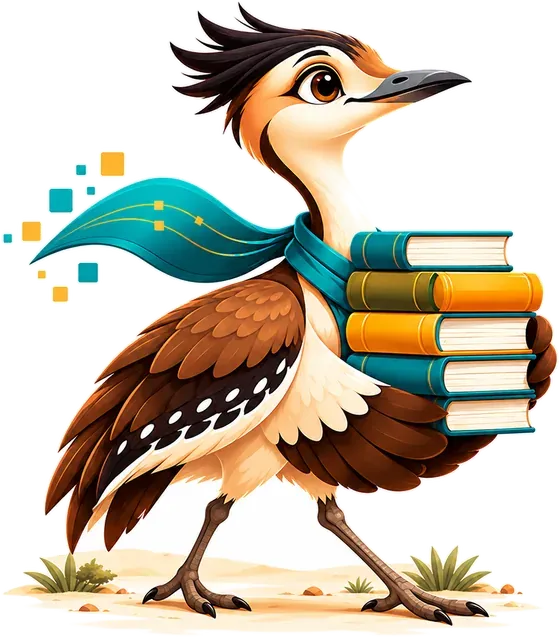
123456- 1Black crest. Its scientific name, nigriceps, means “black-headed”.
- 2Pixels: learning on screens too.
- 3Teal scarf: our colour.
- 4A stack of books.
- 5Wings: the real bird is heavy, but it can fly.
- 6Long legs, for walking through grassland.
Four faces, four jobs
Each face has its own job.
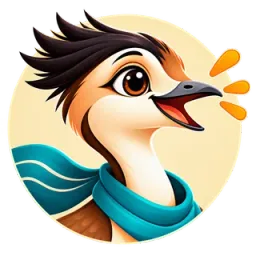
Speaking: a tip
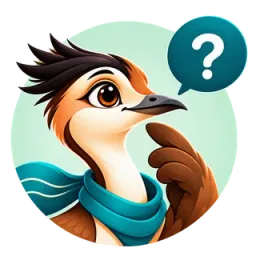
Thinking: a practice question
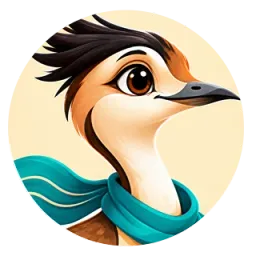
Curious: did you know?
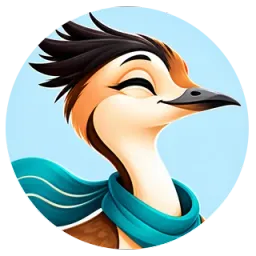
Happy: the right answer
A pose for every place
Each part of the website has its own pose, chosen by what happens there.
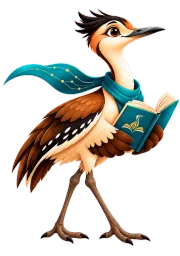
Reading: the home page
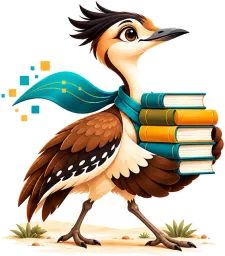
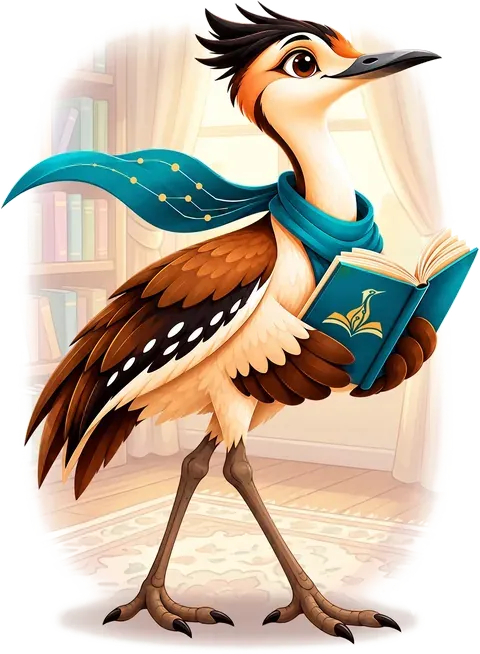
With books: the notes
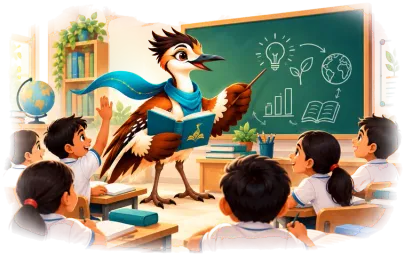
In class: pages for teachers
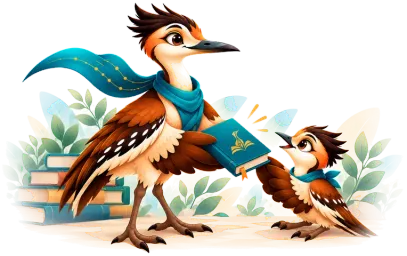
Sharing a book: pages for parents
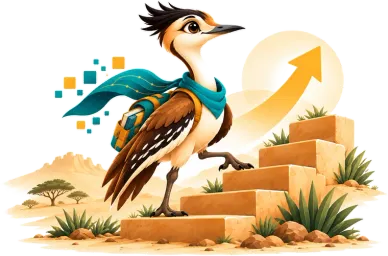
Moving ahead: careers
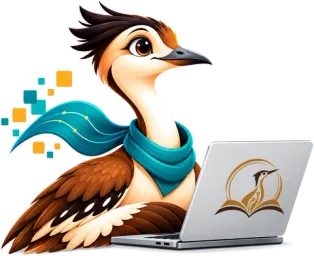
With a computer: how AI is used
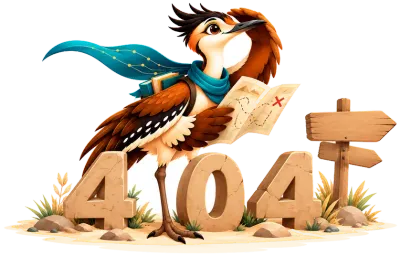
With a map: the “page not found” page
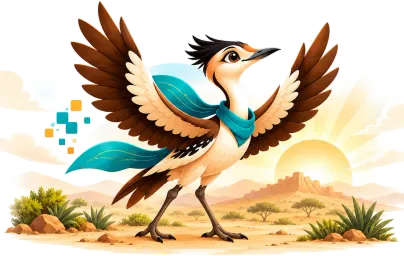
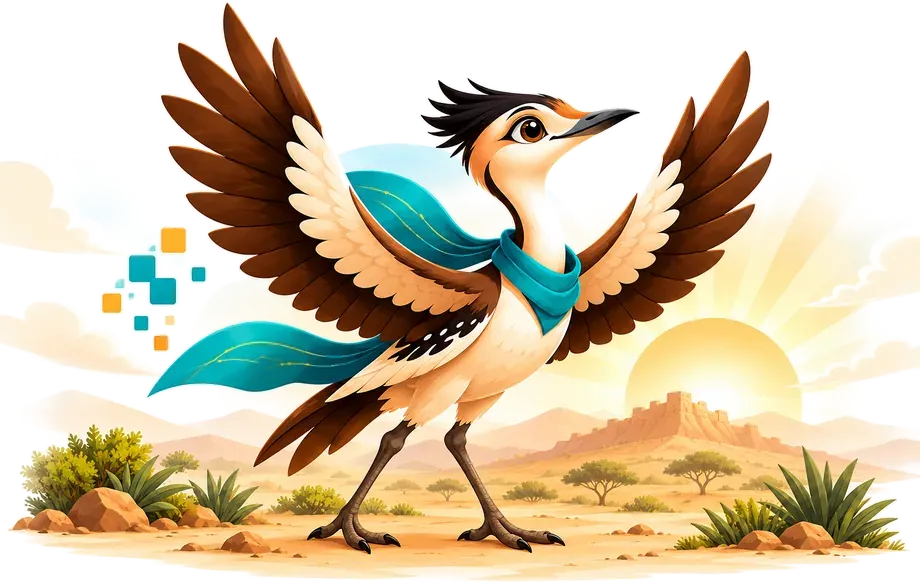
Wings open: this page and some chapters
Three rules for the mascot
One mascot on a screen.
Never beside the bird in the logo.
On a round sun, never in a box.
Part 3 · The real Godawan
Identity card
One of the heaviest flying birds in the world, and one of the rarest.
- Name
- Godawan (Great Indian Bustard)
- Scientific name
- Ardeotis nigriceps
- Other names
- Son Chiriya, Ghorad, Maldhok
- State bird of
- Rajasthan
- Status
- Critically Endangered (IUCN, 2018)
- Protected by
- Schedule I, Wild Life (Protection) Act, 1972
- Weight
- Male 10–15 kg · Female 5–10 kg
- Home
- Grasslands, mostly in the Thar Desert, almost only in India
- Food
- Plants, fruit, crops, insects (grasshoppers, beetles, ants, termites) and reptiles
- Lifespan
- Up to about 28 years (an estimate)
A Godawan’s day, and its family
The mother raises the chicks on her own.
It nests only once a year.
A female first breeds at about 3 years old, a male at about 4.
It grows and breeds slowly, so every bird lost is hard to replace.
How many are left?
Godawans in India, estimates over the years
- 1969about 1,260
- 1978745
- 2000about 600
- around 2011250
- 2019about 150 or fewer
These counts were made in different ways, so read them as rough estimates. Source: India’s proposal to CMS, 2019.
A newer WII estimate for the Thar (130 ± 21) was reported in newspapers in July 2026. We could not find the official report, so it is not in the chart.
In March 2022 the government told Parliament that about 150 are left in India, about 128 of them in Rajasthan, based on studies by the Wildlife Institute of India (WII).
Once in 11 states. By 2022, only 5.
- Rajasthan
- Gujarat
- Maharashtra
- Karnataka
- Andhra Pradesh
In Kutch, Gujarat, only three wild females are left (March 2026).
Apart from these, 97 birds live in the breeding centres at Sam and Ramdevra (October 2026).
What puts it in danger?
- 1Flies low
- 2Heavy body
- 3Thin wires are hard to see from far away
Power lines
It is heavy and flies low, so it crashes into wires it cannot see from far away.
Grasslands lost
Grasslands are often called “wasteland” and taken for other uses.
Eggs and chicks attacked
Stray dogs and pigs, and foxes, mongooses and cats, raid nests and chicks.
Hunting, in the past
Hunting and egg collecting had cut their numbers to about 1,260 by 1969.
Saving it: the breeding programme
Eggs are hatched safely, chicks are raised, and now birds have begun to go back to the wild.
In the centres, October 2026
97 birds: 40 hatched from eggs laid in the wild, 57 bred in the centres. 86 stay for breeding. 11 are set aside to go back to the wild, and 2 of them were released on 4 October.
Chicks born in the centres: 24 in 2025, 29 in 2026.
Jumpstart: an egg laid in a centre is placed in a wild nest, and the wild female hatches it. Six chicks in Rajasthan and two in Gujarat have hatched this way.
- 2013
Rajasthan starts Project Great Indian Bustard. Its forest department says it was the first state to do so.
- 2016
A national programme for the bird’s home and its breeding is approved, with ₹33.85 crore.
- June 2019
A temporary breeding centre opens at Sam, Jaisalmer. Eggs collected from the wild are hatched there.
- March 2022
16 chicks are being raised at Sam.
- August 2022
A long-term centre starts working at Ramdevra.
- March 2023
A chick hatches from an egg laid at Sam by birds raised there. WII calls it the first time anywhere in the world that the bird has bred in captivity.
- 2024
₹77.05 crore is approved for a five-year plan for the Godawan and the Lesser Florican.
- March 2026
An egg from the programme travels 770 km by road to Kutch, Gujarat, and is placed in a wild female’s nest. It hatches on 26 March: Gujarat’s first Godawan chick in a decade.
- June 2026
26 chicks so far this season, 18 of them by artificial insemination.
- 3 October 2026
A huge Rewilding Aviary opens at Ramdevra: 160 m long, 64 m wide and 14 m high. Birds from the centres build their flying muscles here.
- 4 October 2026
Two male Godawans from the programme are released into the wild at Sam, in Desert National Park.
Power lines and the Supreme Court
A case about power lines in the Godawan’s home was before the Supreme Court from 2019 until December 2025.
- April 2021
The Court orders bird diverters on existing lines in the bird’s areas at once, and lines put underground within a year wherever that is possible.
- March 2024
The Court lifts the 2021 limit on overhead lines (about 99,000 sq km), on condition that an expert committee lays down rules. The committee reports on Rajasthan in September 2024.
- 19 December 2025
The Court gives its final directions and closes the case. Priority areas for the bird: 14,013 sq km in Rajasthan and 740 sq km in Gujarat.
Inside the priority areas
- No new overhead power lines, except along one set power corridor. Small lines of 11 kV and below are exempt.
- No new wind turbines.
- No new solar parks above 2 MW, and no growing the old ones.
Ordered for Rajasthan, within two years (by December 2027)
- 80 km of 33 kV lines go underground, starting at once.
- 250 km of lines that WII identified as critical go underground.
- Some big lines (66 kV and above) move to new routes.
Bird diverters
Markers hung on wires so birds can see them. More than half the lines in the area already have them. The Court did not order more: it asked for a scientific test first and left the decision to the authorities.
Ordered is not the same as done. As of 5 October 2026 we found no official figure for how much of this work is finished.
Where does it live?
Rajasthan: the Thar
Most Godawans live here, in and around Desert National Park in Jaisalmer and Barmer. The park covers 3,162 sq km and was set up in 1980. Inside it, about 200 sq km of grassland is fenced off: the bird’s best breeding ground.
Rajasthan: the breeding centres
Sam and Ramdevra, both in Jaisalmer district.
Gujarat: Kutch
Only three wild females were left (March 2026). The jumpstart chick hatched here.
Maharashtra, Karnataka, Andhra Pradesh
Fewer than 10 in each (told to Parliament, March 2022).
What can you do?
Four small things that help.
Keep far away and quiet. Never go near eggs or chicks.
Grassland is not wasteland. Say so at home.
Seen a hurt or dead bird? Tell the forest department.
Tell three friends the Godawan’s story.
Where these facts come from
Every fact on this page was checked against these records on 5 October 2026. Numbers change, so always look at the date.
- Rajasthan Forest Department: Project Great Indian Bustard
- PIB, 14 March 2022: Protection of Great Indian Bustards (reply in Parliament)
- PIB, 27 March 2023: Conservation Plan for Great Indian Bustards
- PIB, 12 December 2024: Conservation status of the Great Indian Bustard (reply in Parliament)
- PIB, 28 March 2026: Godawan chick hatches in Gujarat after a decade
- PIB, 14 June 2026: captive stock reaches 94 birds
- PIB, 3 October 2026: the Rewilding Aviary and the start of release
- PIB, 4 October 2026: two males released at Desert National Park
- Wildlife Institute of India: Great Indian Bustard report, 2020
- Wildlife Institute of India: Bustard Recovery Program annual report, 2023
- India’s proposal to list the Great Indian Bustard under CMS, 2019 (COP13 Doc. 27.1.4)
- Supreme Court of India: order of 19 April 2021
- Supreme Court of India: judgment of 21 March 2024 (2024 INSC 280)
- Supreme Court of India: judgment of 19 December 2025 (2025 INSC 1472)
- Incredible India (Ministry of Tourism): Desert National Park